> ## Documentation Index
> Fetch the complete documentation index at: https://infisical.com/docs/llms.txt
> Use this file to discover all available pages before exploring further.
# Azure Client Secrets Connection
> Learn how to configure an Azure Client Secrets Connection for Infisical.
Infisical currently only supports two methods for connecting to Azure, which are OAuth and Client Secrets.
Using the Azure Client Secrets connection on a self-hosted instance of Infisical requires configuring an application in Azure
and registering your instance with it.
**Prerequisites:**
* Set up Azure.
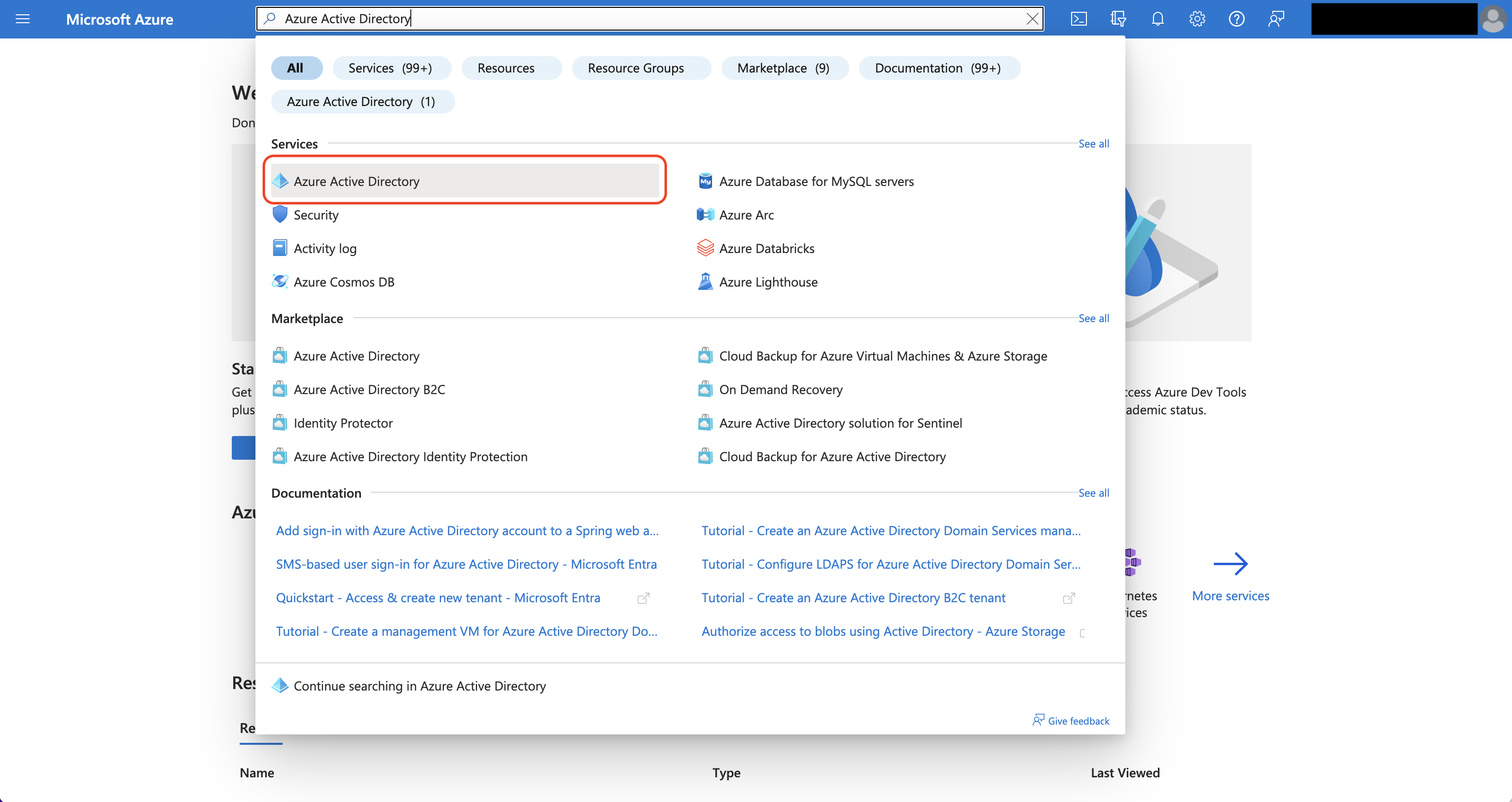
Navigate to Azure Active Directory > App registrations to create a new application.
Azure Active Directory is now Microsoft Entra ID.
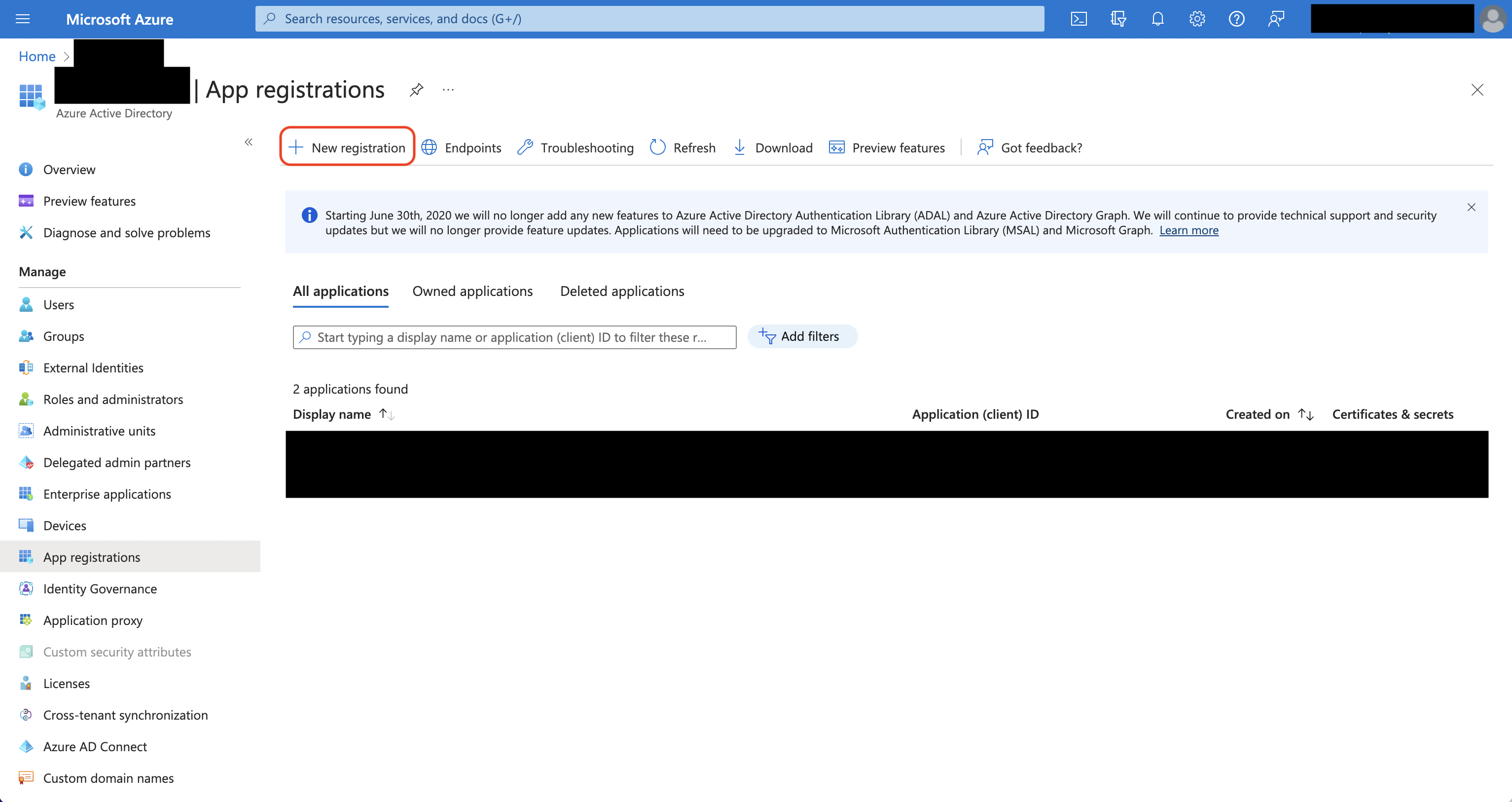 Create the application. As part of the form, set the **Redirect URI** to `https://your-domain.com/organization/app-connections/azure/oauth/callback`.
The domain you defined in the Redirect URI should be equivalent to the `SITE_URL` configured in your Infisical instance.
Create the application. As part of the form, set the **Redirect URI** to `https://your-domain.com/organization/app-connections/azure/oauth/callback`.
The domain you defined in the Redirect URI should be equivalent to the `SITE_URL` configured in your Infisical instance.
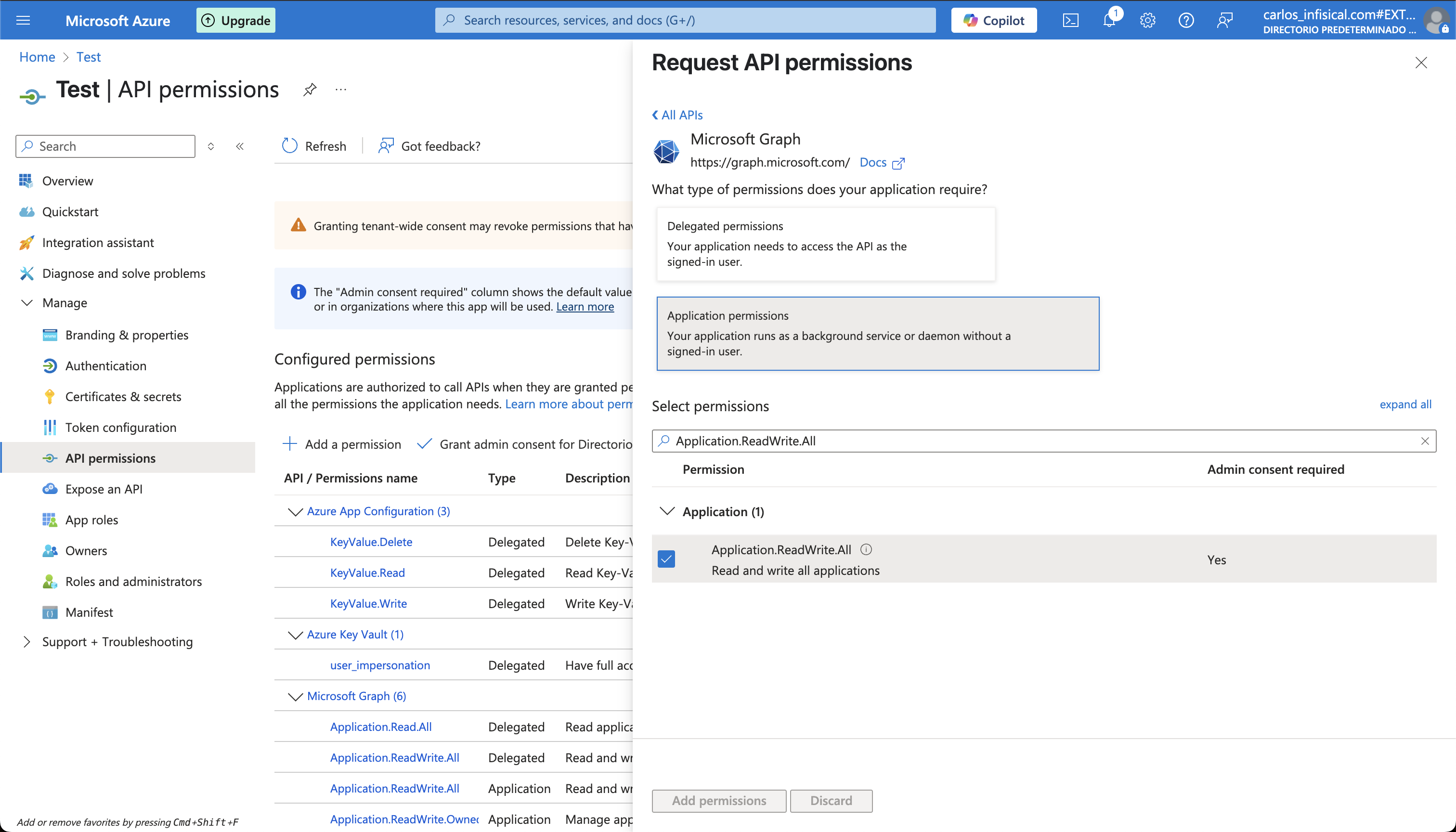
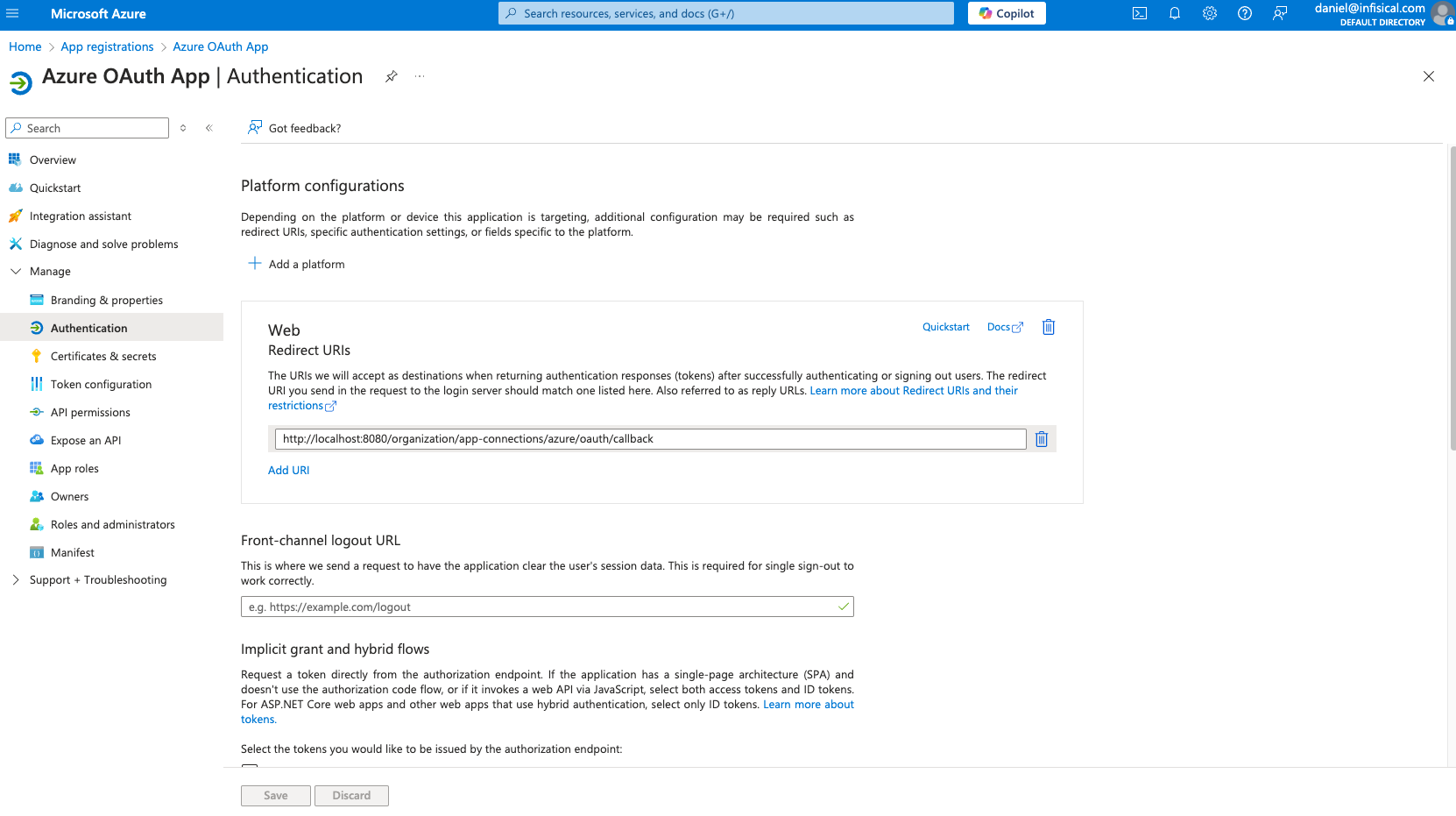 For the Azure Connection to work with Client Secrets, you need to assign the following permission to the application.
#### Azure Client Secrets permissions
Set the API permissions of the Azure application to include the following permissions:
* Microsoft Graph
* `Application.ReadWrite.All`
* `Application.ReadWrite.OwnedBy`
* `Application.ReadWrite.All` (Delegated)
* `Directory.ReadWrite.All` (Delegated)
* `User.Read` (Delegated)
For the Azure Connection to work with Client Secrets, you need to assign the following permission to the application.
#### Azure Client Secrets permissions
Set the API permissions of the Azure application to include the following permissions:
* Microsoft Graph
* `Application.ReadWrite.All`
* `Application.ReadWrite.OwnedBy`
* `Application.ReadWrite.All` (Delegated)
* `Directory.ReadWrite.All` (Delegated)
* `User.Read` (Delegated)
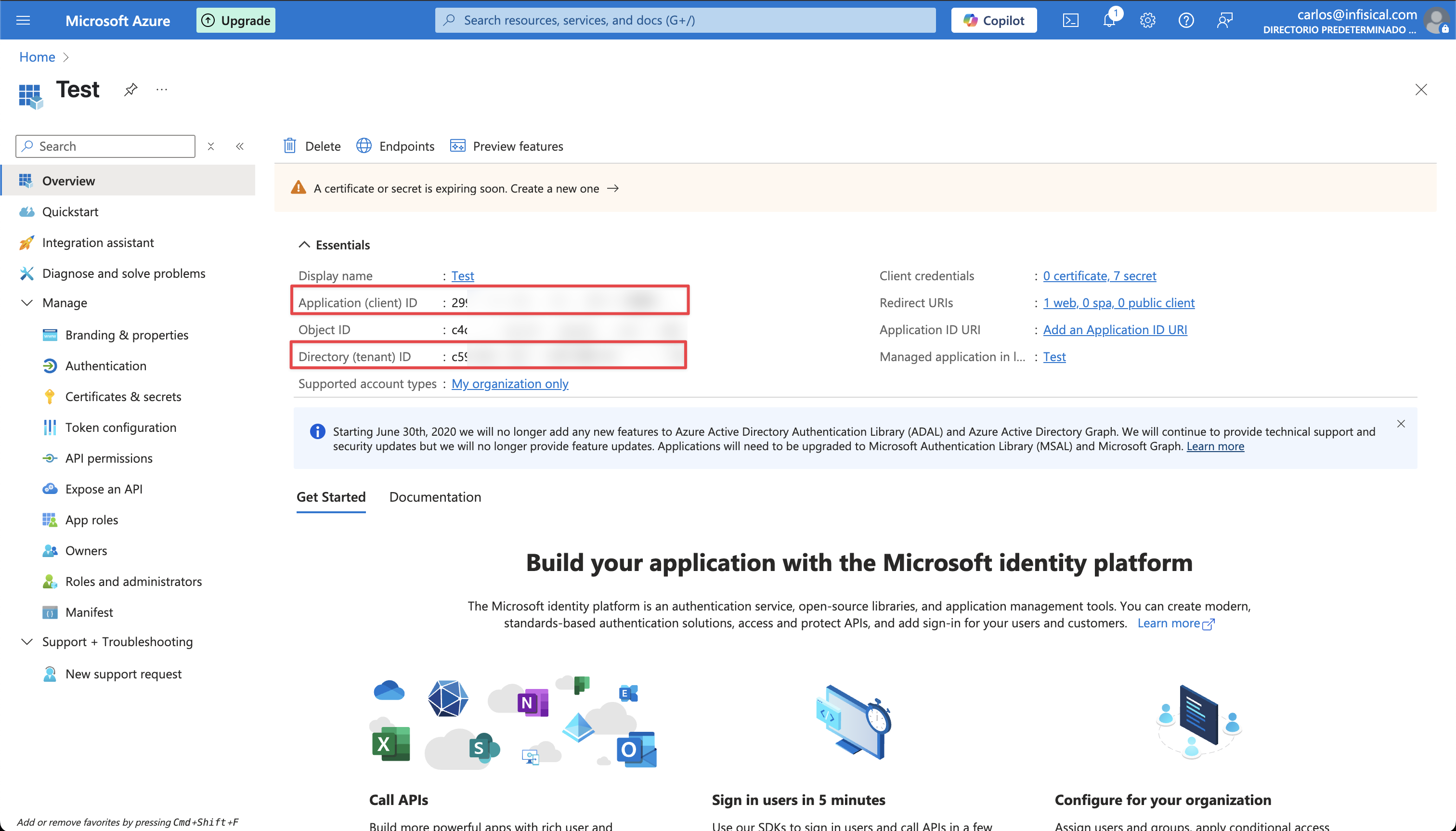
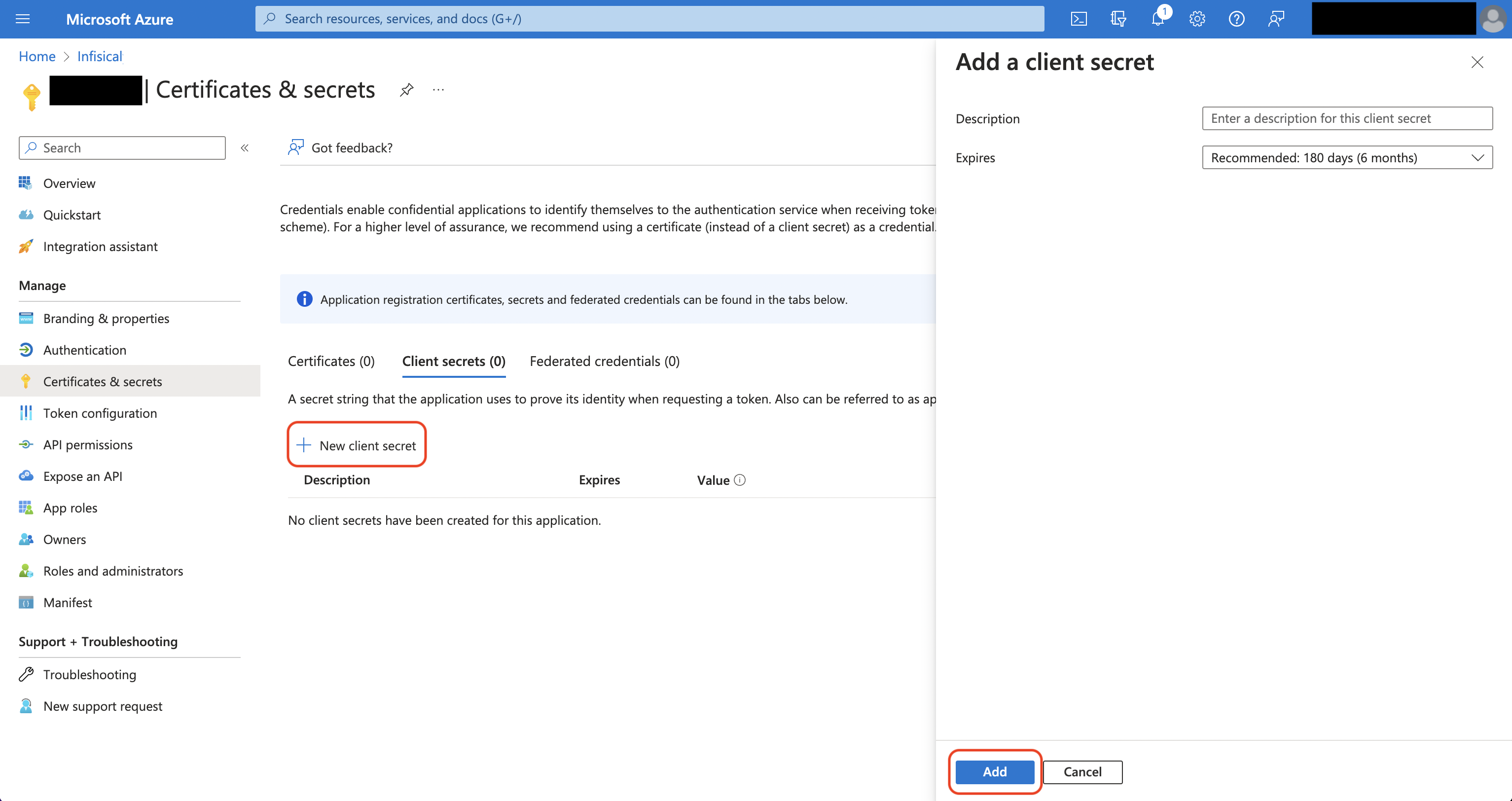
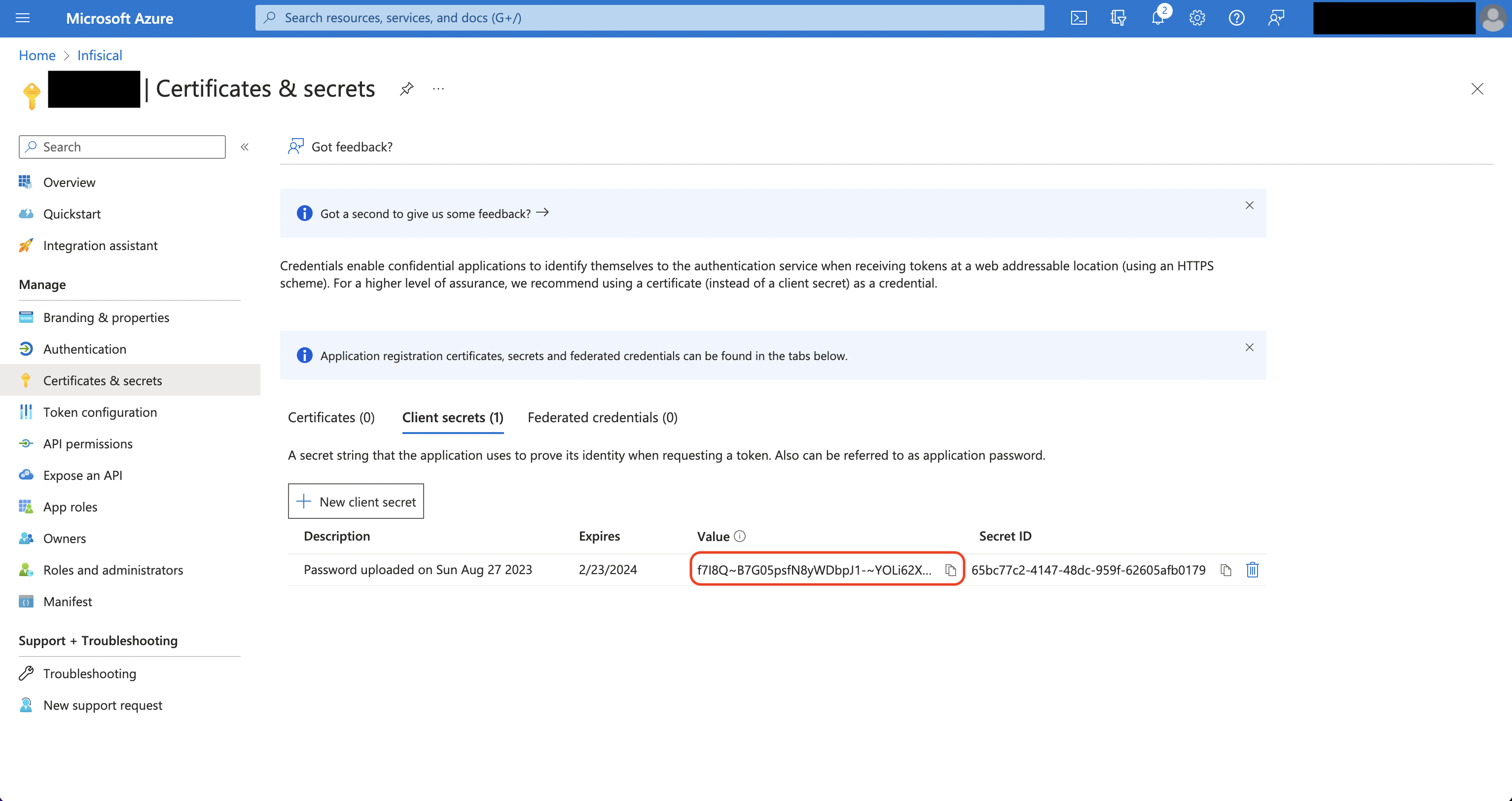
 Obtain the **Application (Client) ID** and **Directory (Tenant) ID** (this will be used later in the Infisical connection) in Overview and generate a **Client Secret** in Certificate & secrets for your Azure application.
 Back in your Infisical instance, add two new environment variables for the credentials of your Azure application.
* `INF_APP_CONNECTION_AZURE_CLIENT_SECRETS_CLIENT_ID`: The **Application (Client) ID** of your Azure application.
* `INF_APP_CONNECTION_AZURE_CLIENT_SECRETS_CLIENT_SECRET`: The **Client Secret** of your Azure application.
Once added, restart your Infisical instance and use the Azure Client Secrets connection.
Ensure your Azure application has the required permissions that Infisical needs for the Azure Client Secrets connection to work.
**Prerequisites:**
* An active Azure setup.
For the Azure Client Secrets connection to work, assign the following permissions to your Azure application:
#### Required API Permissions
**Microsoft Graph**
* `Application.ReadWrite.All`
* `Application.ReadWrite.OwnedBy`
* `Application.ReadWrite.All` (Delegated)
* `Directory.ReadWrite.All` (Delegated)
* `User.Read` (Delegated)
Ensure your Azure application has the required permissions that Infisical needs for the Azure Client Secrets connection to work.
**Prerequisites:**
* An active Azure setup.
For the Azure Client Secrets connection to work, assign the following permissions to your Azure application:
#### Required API Permissions
**Microsoft Graph**
* `Application.ReadWrite.All`
* `Application.ReadWrite.OwnedBy`
* `Application.ReadWrite.All` (Delegated)
* `Directory.ReadWrite.All` (Delegated)
* `User.Read` (Delegated)
Navigate to the **Certificates & secrets** section of your Azure App Registration, and press the **Upload certificate** button.
Select the **Upload** button and upload your certificate.
Back in your Infisical instance, add two new environment variables for the credentials of your Azure application.
* `INF_APP_CONNECTION_AZURE_CLIENT_SECRETS_CLIENT_ID`: The **Application (Client) ID** of your Azure application.
* `INF_APP_CONNECTION_AZURE_CLIENT_SECRETS_CLIENT_SECRET`: The **Client Secret** of your Azure application.
Once added, restart your Infisical instance and use the Azure Client Secrets connection.
Ensure your Azure application has the required permissions that Infisical needs for the Azure Client Secrets connection to work.
**Prerequisites:**
* An active Azure setup.
For the Azure Client Secrets connection to work, assign the following permissions to your Azure application:
#### Required API Permissions
**Microsoft Graph**
* `Application.ReadWrite.All`
* `Application.ReadWrite.OwnedBy`
* `Application.ReadWrite.All` (Delegated)
* `Directory.ReadWrite.All` (Delegated)
* `User.Read` (Delegated)
Ensure your Azure application has the required permissions that Infisical needs for the Azure Client Secrets connection to work.
**Prerequisites:**
* An active Azure setup.
For the Azure Client Secrets connection to work, assign the following permissions to your Azure application:
#### Required API Permissions
**Microsoft Graph**
* `Application.ReadWrite.All`
* `Application.ReadWrite.OwnedBy`
* `Application.ReadWrite.All` (Delegated)
* `Directory.ReadWrite.All` (Delegated)
* `User.Read` (Delegated)
Navigate to the **Certificates & secrets** section of your Azure App Registration, and press the **Upload certificate** button.
Select the **Upload** button and upload your certificate.
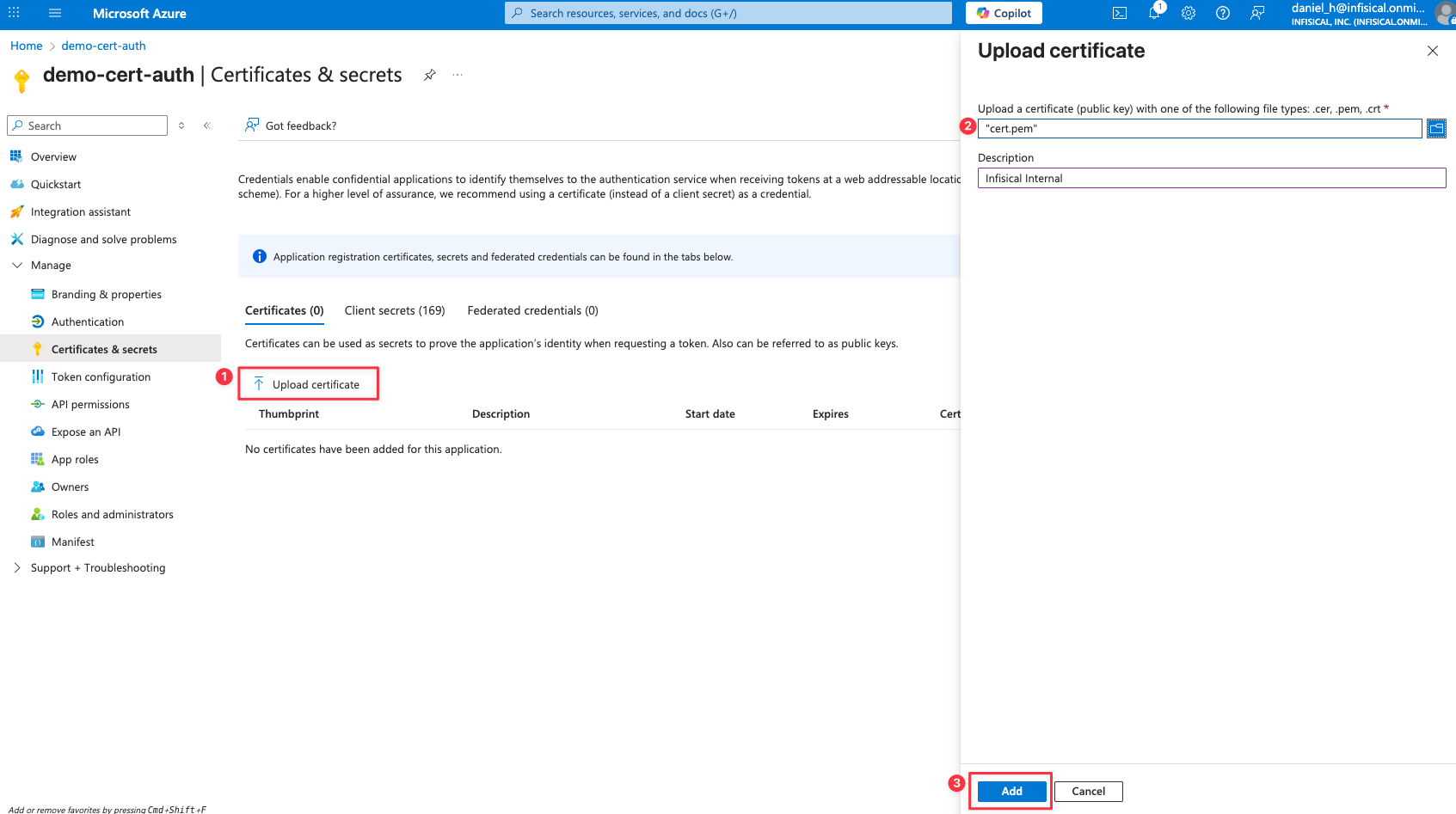 Keep in mind that both the certificate and its private key are required to configure the Azure Client Secrets connection in Infisical.
## Setup Azure Connection in Infisical
Navigate to the **Integrations** tab in the desired project, then select **App Connections**.
Keep in mind that both the certificate and its private key are required to configure the Azure Client Secrets connection in Infisical.
## Setup Azure Connection in Infisical
Navigate to the **Integrations** tab in the desired project, then select **App Connections**.  Select the **Azure Connection** option from the connection options modal.
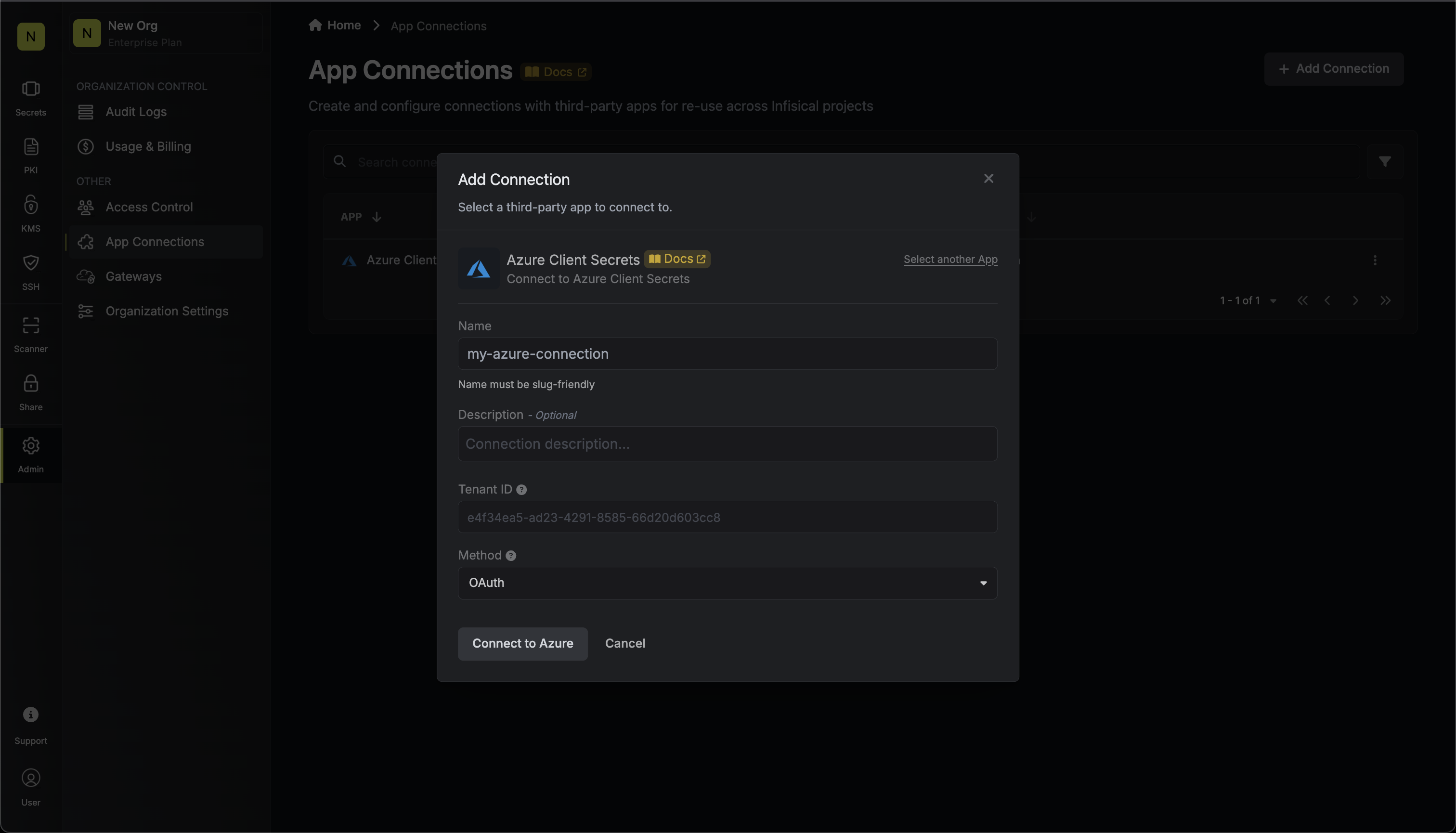
 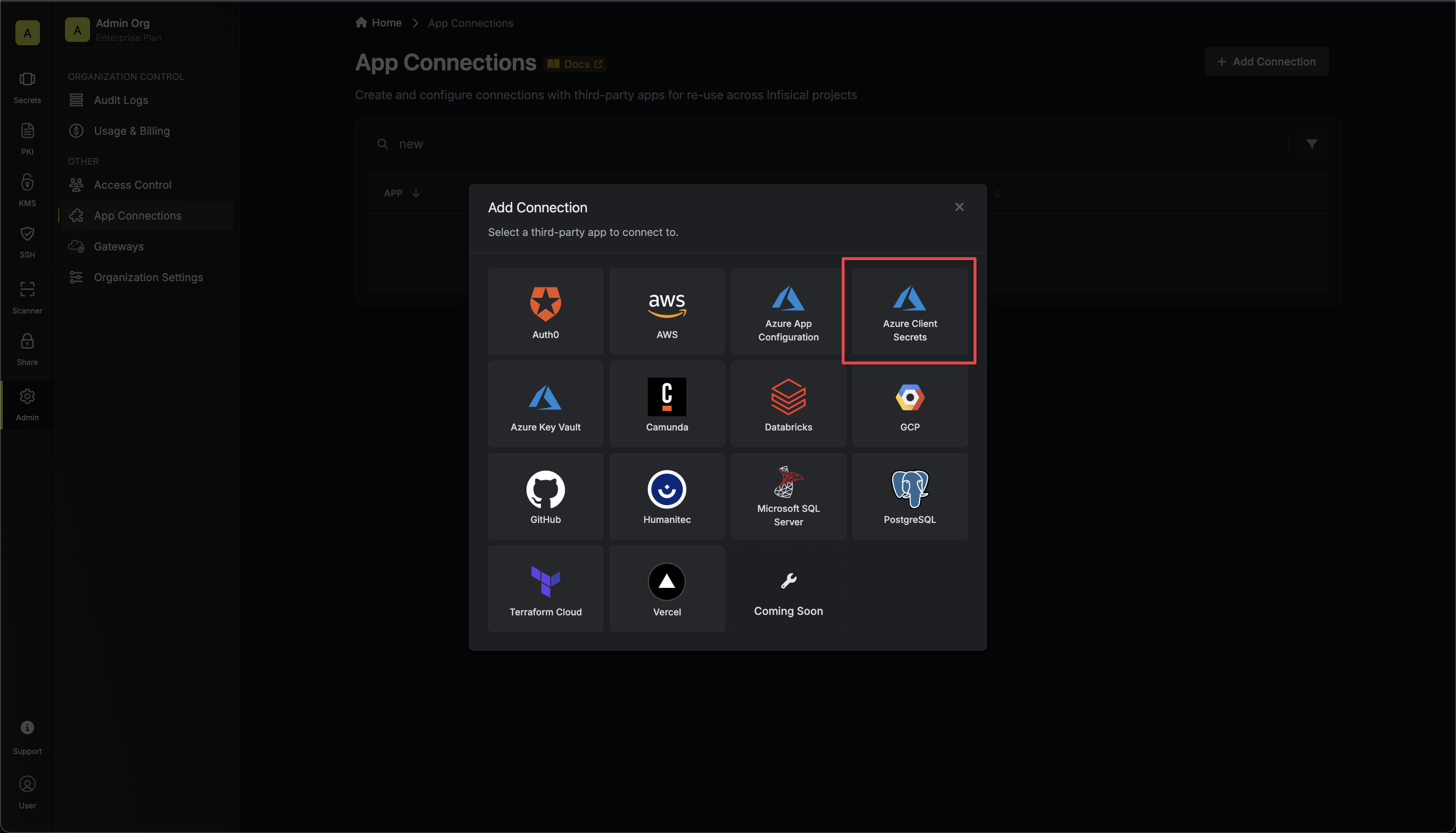 Fill in the **Tenant ID** field with the Directory (Tenant) ID you obtained in the previous step.
Now select the **OAuth** method and click **Connect to Azure**.
Fill in the **Tenant ID** field with the Directory (Tenant) ID you obtained in the previous step.
Now select the **OAuth** method and click **Connect to Azure**.
 You will then be redirected to Azure to grant Infisical access to your Azure account. Once granted,
you will be redirected back to Infisical's App Connections page.
You will then be redirected to Azure to grant Infisical access to your Azure account. Once granted,
you will be redirected back to Infisical's App Connections page. 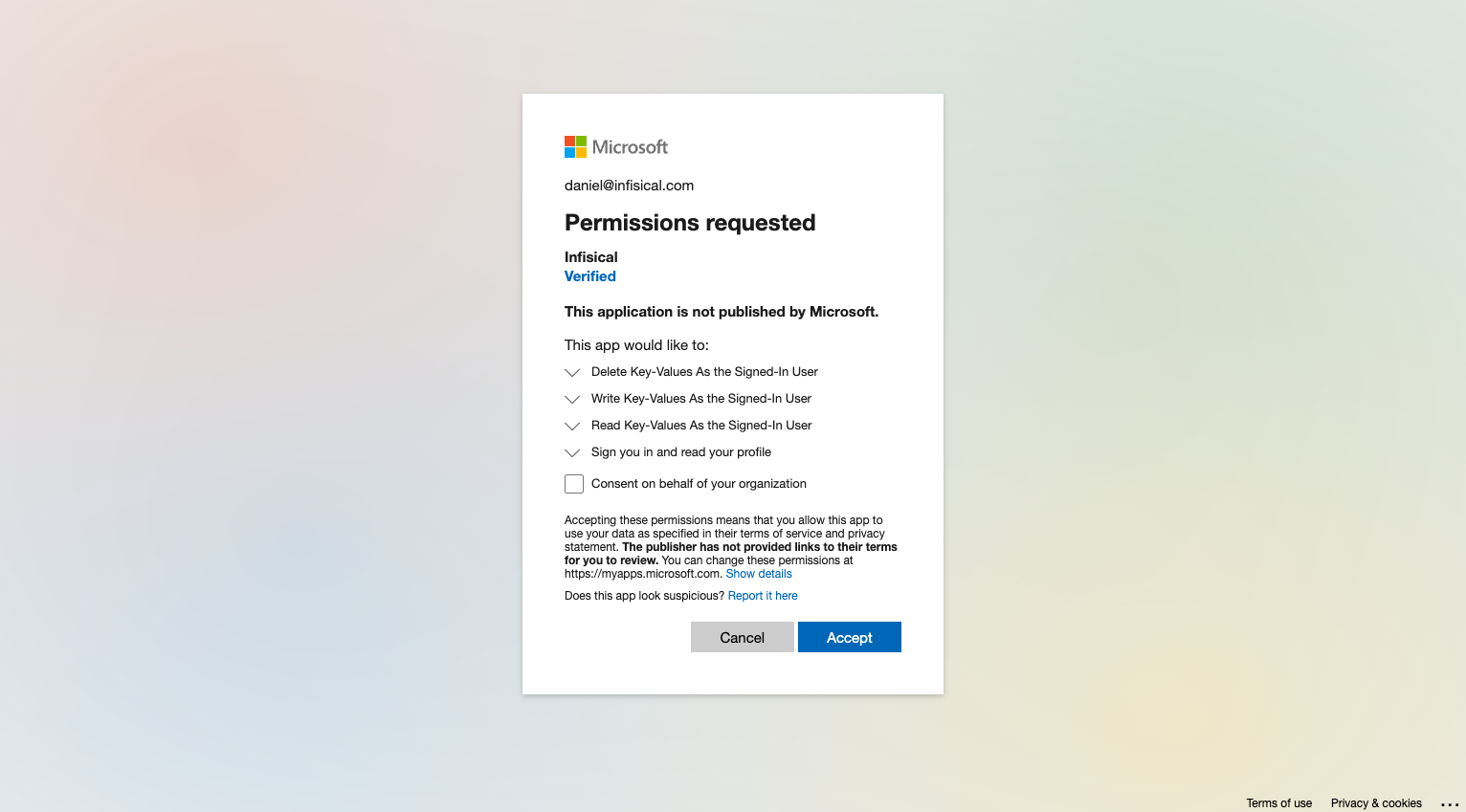 Fill in the **Tenant ID**, **Client ID** and **Client Secret** fields with the Directory (Tenant) ID, Application (Client) ID and Client Secret you obtained in the previous step.
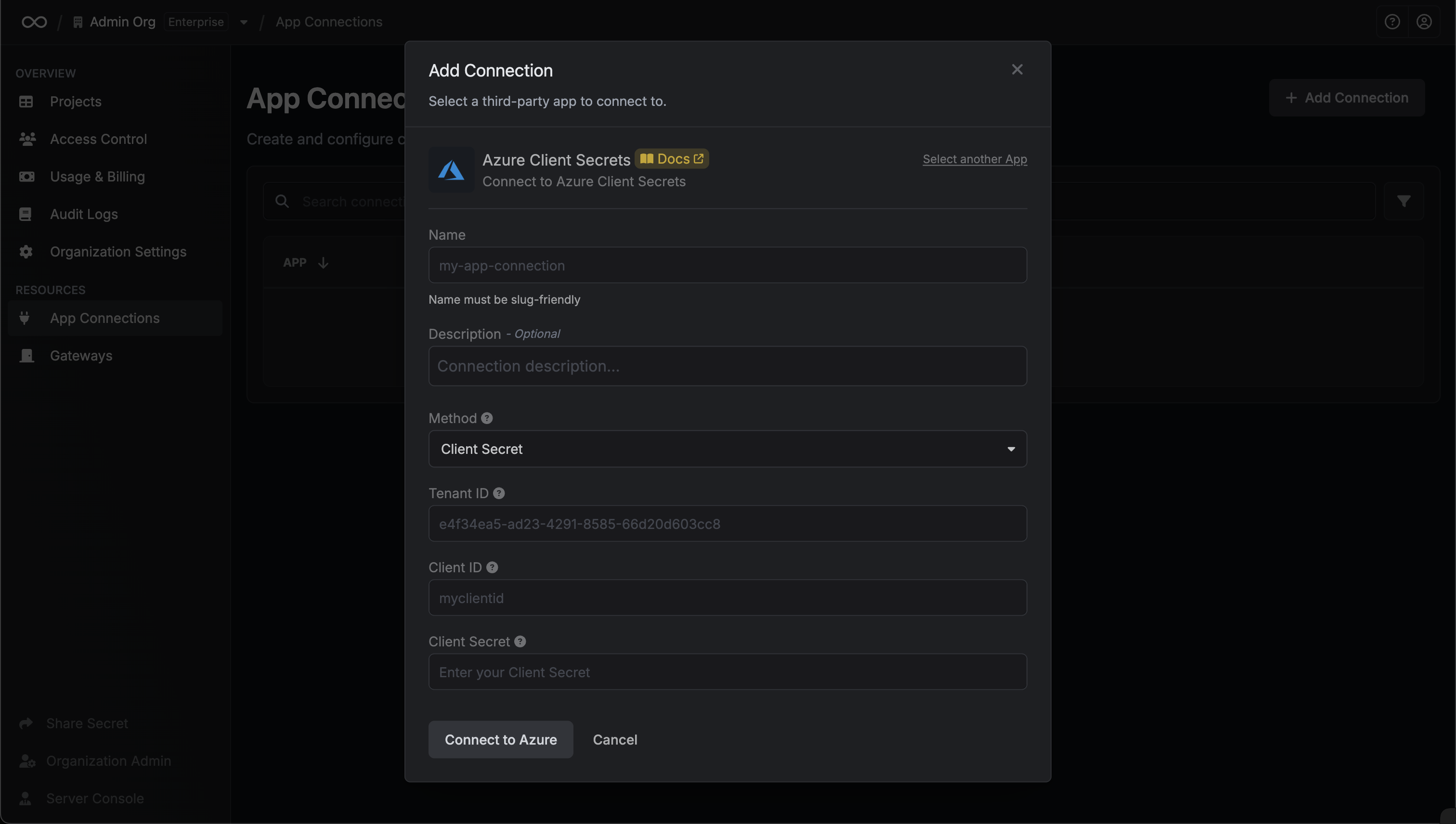 You can optionally enable **Automatic Credential Rotation** for this connection. See the [Automatic Credential Rotation](#automatic-credential-rotation) section below for details.
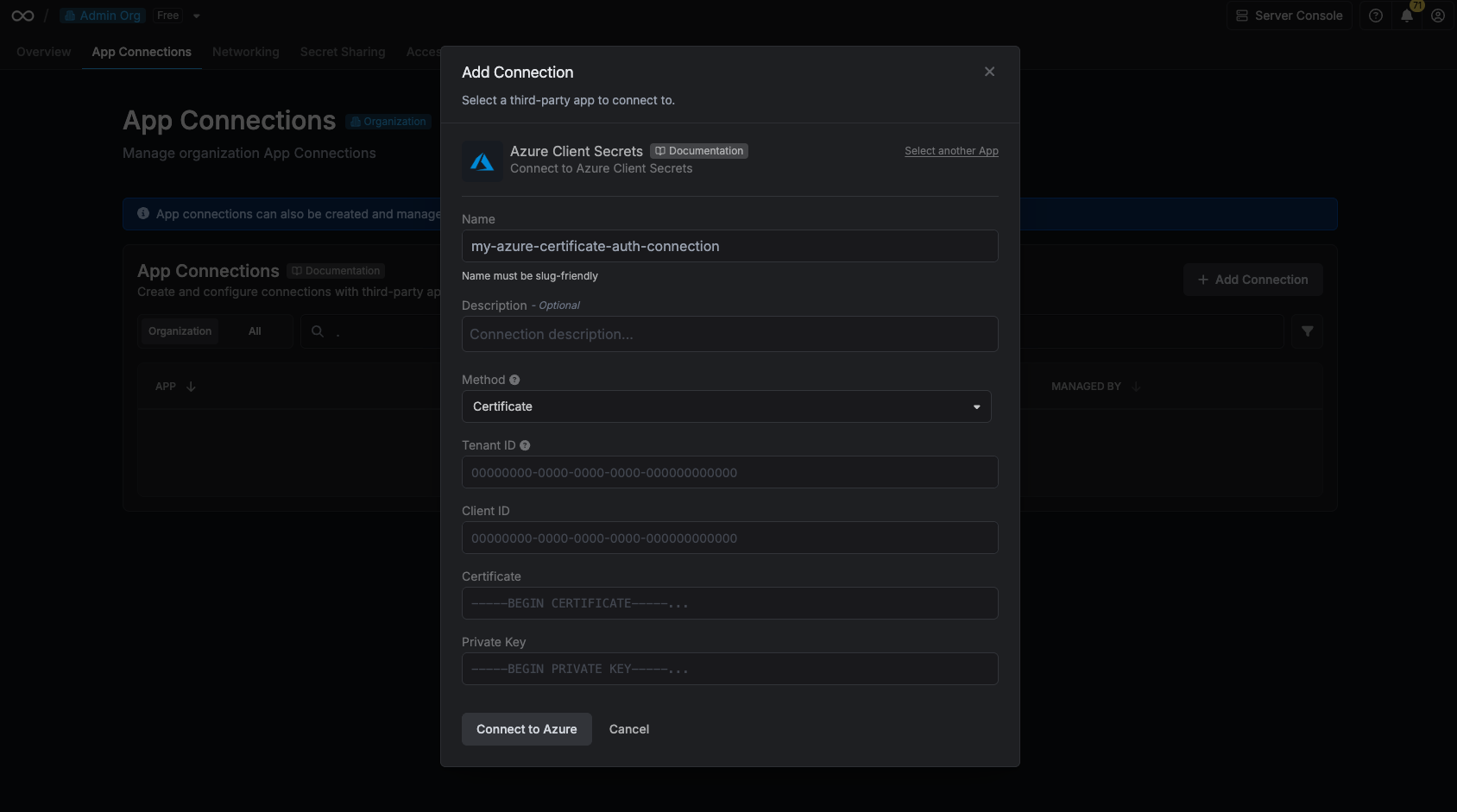
Fill in the **Tenant ID**, **Client ID**, **Certificate (PEM format)**, and **Private Key** fields with the Directory (Tenant) ID, Application (Client) ID, Certificate and Private Key you obtained in the [previous step](#certificate-authentication).
The private key is never transmitted to Azure, and it is only used to sign the client assertion used to authenticate with Azure.
You can optionally enable **Automatic Credential Rotation** for this connection. See the [Automatic Credential Rotation](#automatic-credential-rotation) section below for details.
Fill in the **Tenant ID**, **Client ID**, **Certificate (PEM format)**, and **Private Key** fields with the Directory (Tenant) ID, Application (Client) ID, Certificate and Private Key you obtained in the [previous step](#certificate-authentication).
The private key is never transmitted to Azure, and it is only used to sign the client assertion used to authenticate with Azure.
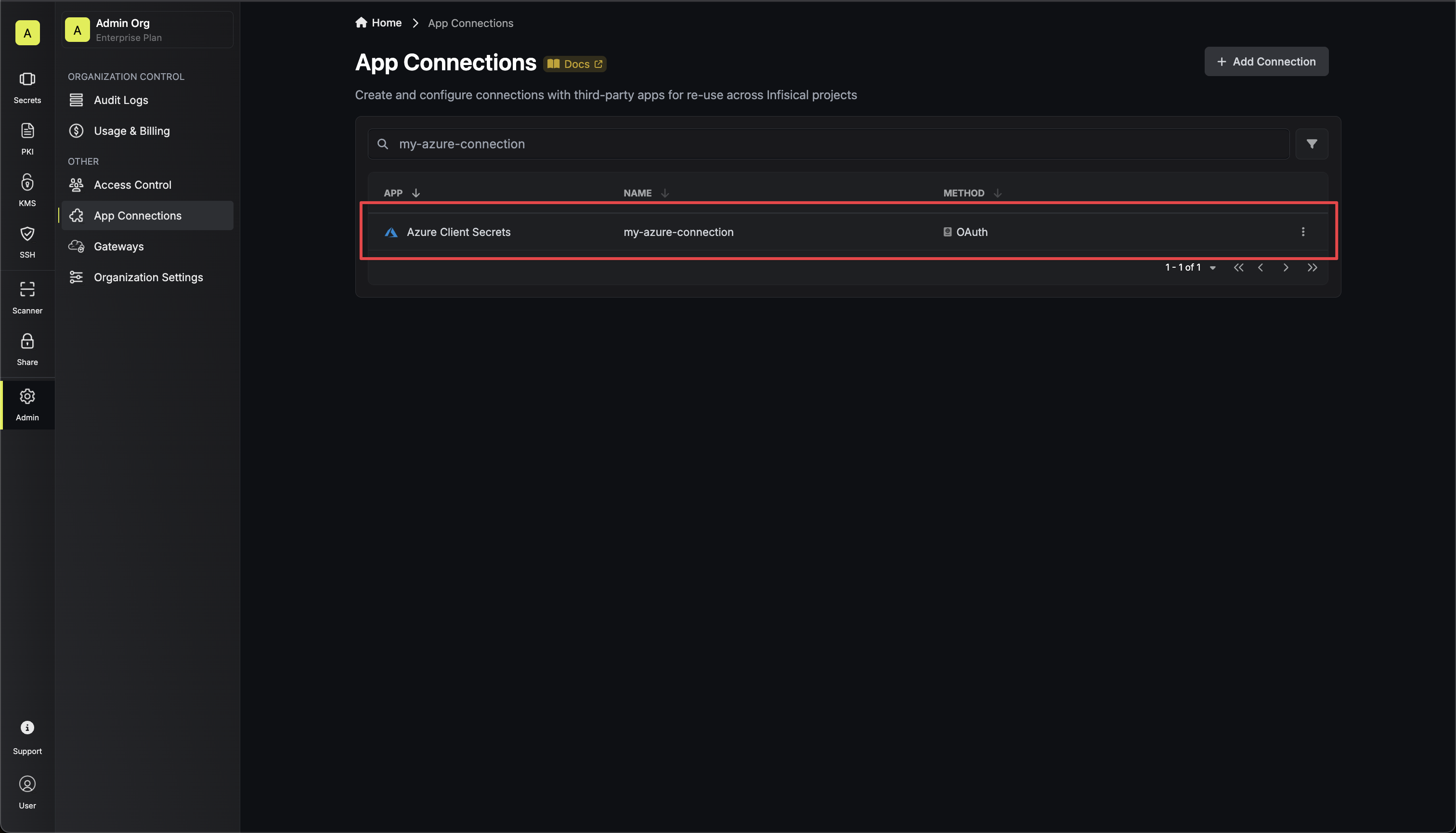
 Your **Azure Client Secrets Connection** is now available for use.
  ## Automatic Credential Rotation
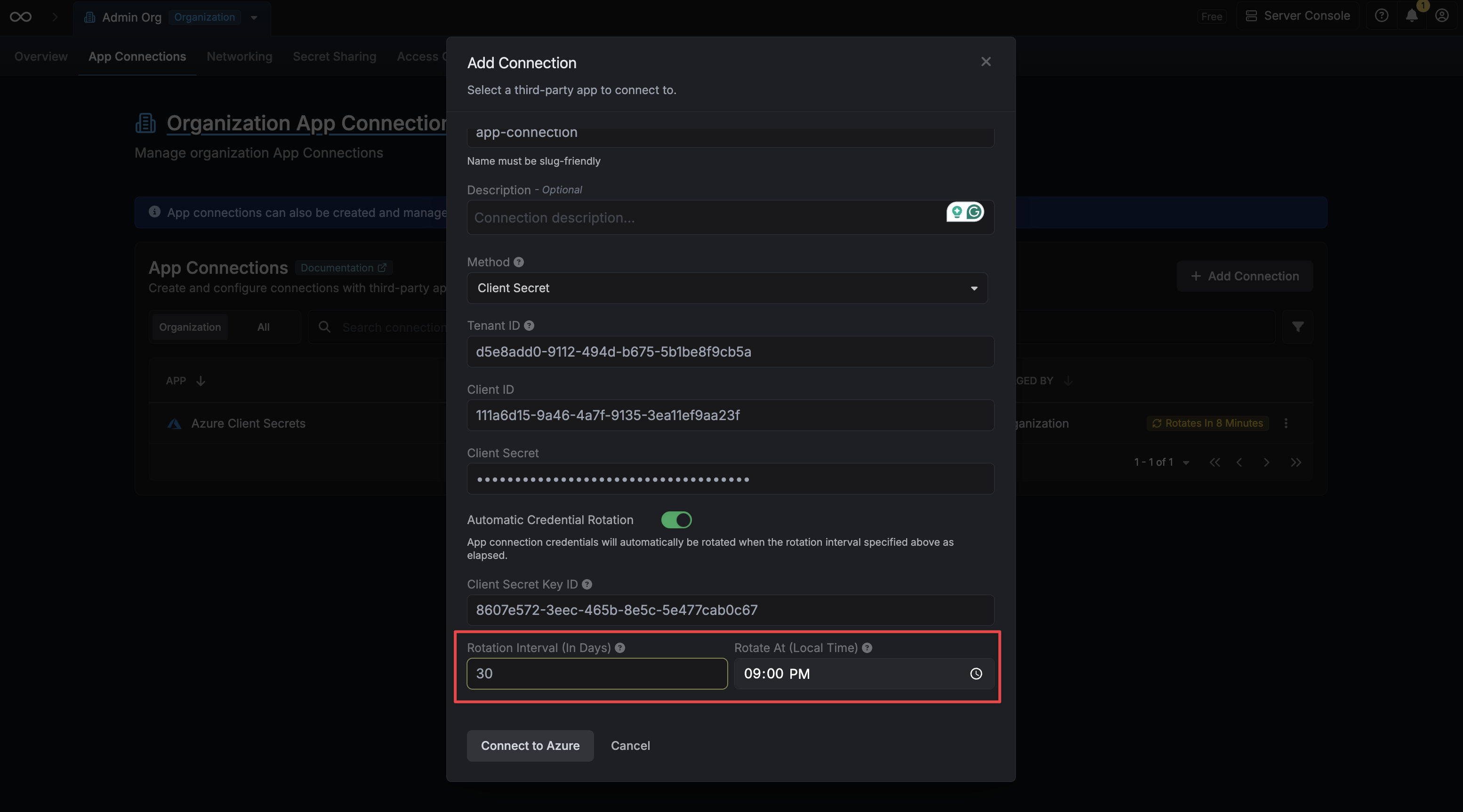
When using the **Client Secret** authentication method, Infisical can automatically rotate the Client Secret of your Azure application on a recurring schedule. When enabled, Infisical will immediately generate a new Client Secret on connection creation and revoke the original one, ensuring that no external party retains access using the credentials you provided.
Automatic Credential Rotation is only available for the **Client Secret** authentication method.
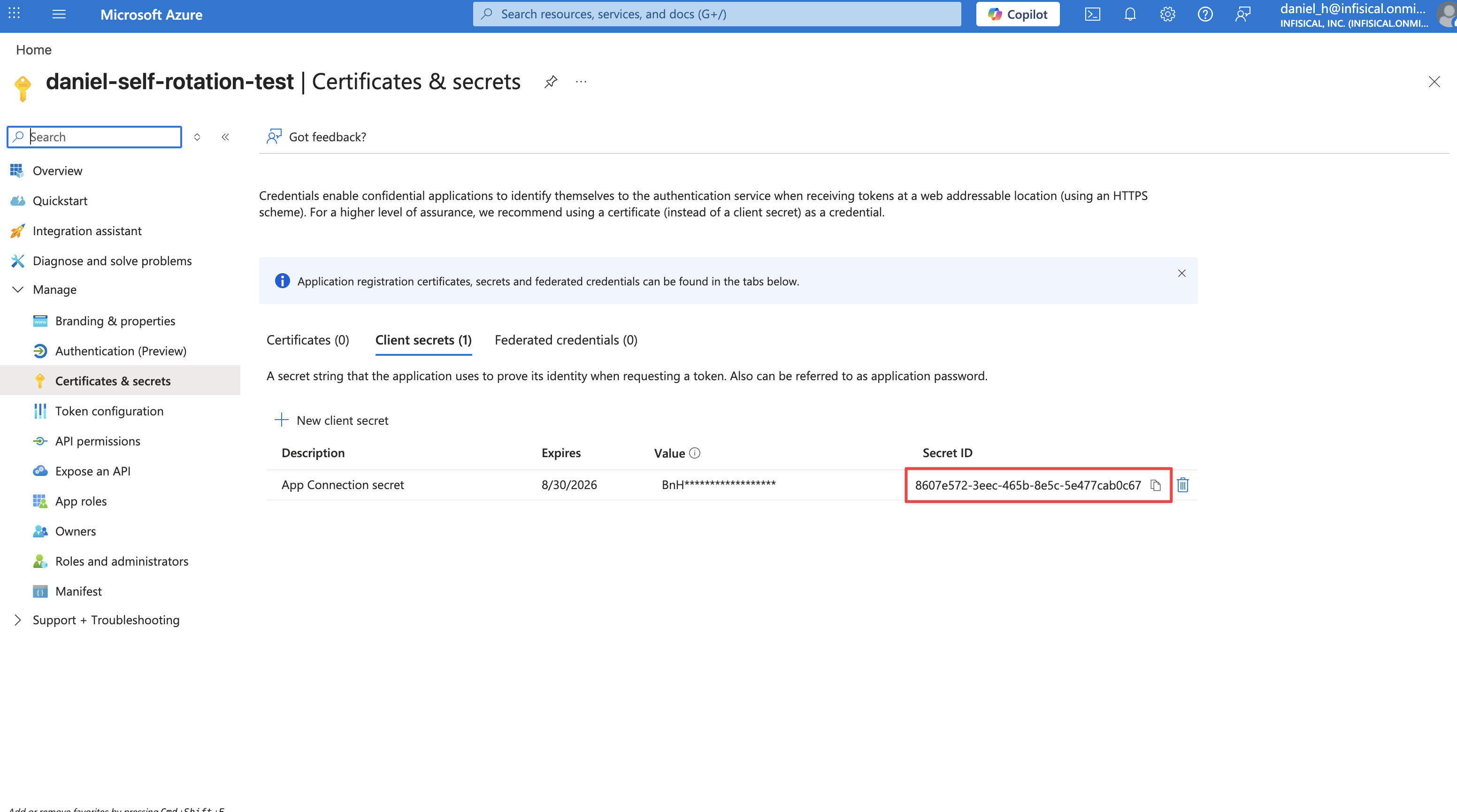
Before enabling rotation, you'll need the **Key ID** of the Client Secret you are using to authenticate. Navigate to your App Registration in the Azure Portal, then go to **Certificates & secrets**. Copy the **Secret ID** (Key ID) of the secret you are providing to Infisical.
## Automatic Credential Rotation
When using the **Client Secret** authentication method, Infisical can automatically rotate the Client Secret of your Azure application on a recurring schedule. When enabled, Infisical will immediately generate a new Client Secret on connection creation and revoke the original one, ensuring that no external party retains access using the credentials you provided.
Automatic Credential Rotation is only available for the **Client Secret** authentication method.
Before enabling rotation, you'll need the **Key ID** of the Client Secret you are using to authenticate. Navigate to your App Registration in the Azure Portal, then go to **Certificates & secrets**. Copy the **Secret ID** (Key ID) of the secret you are providing to Infisical.
 When creating or editing your connection, toggle on the **Automatic Credential Rotation** switch.
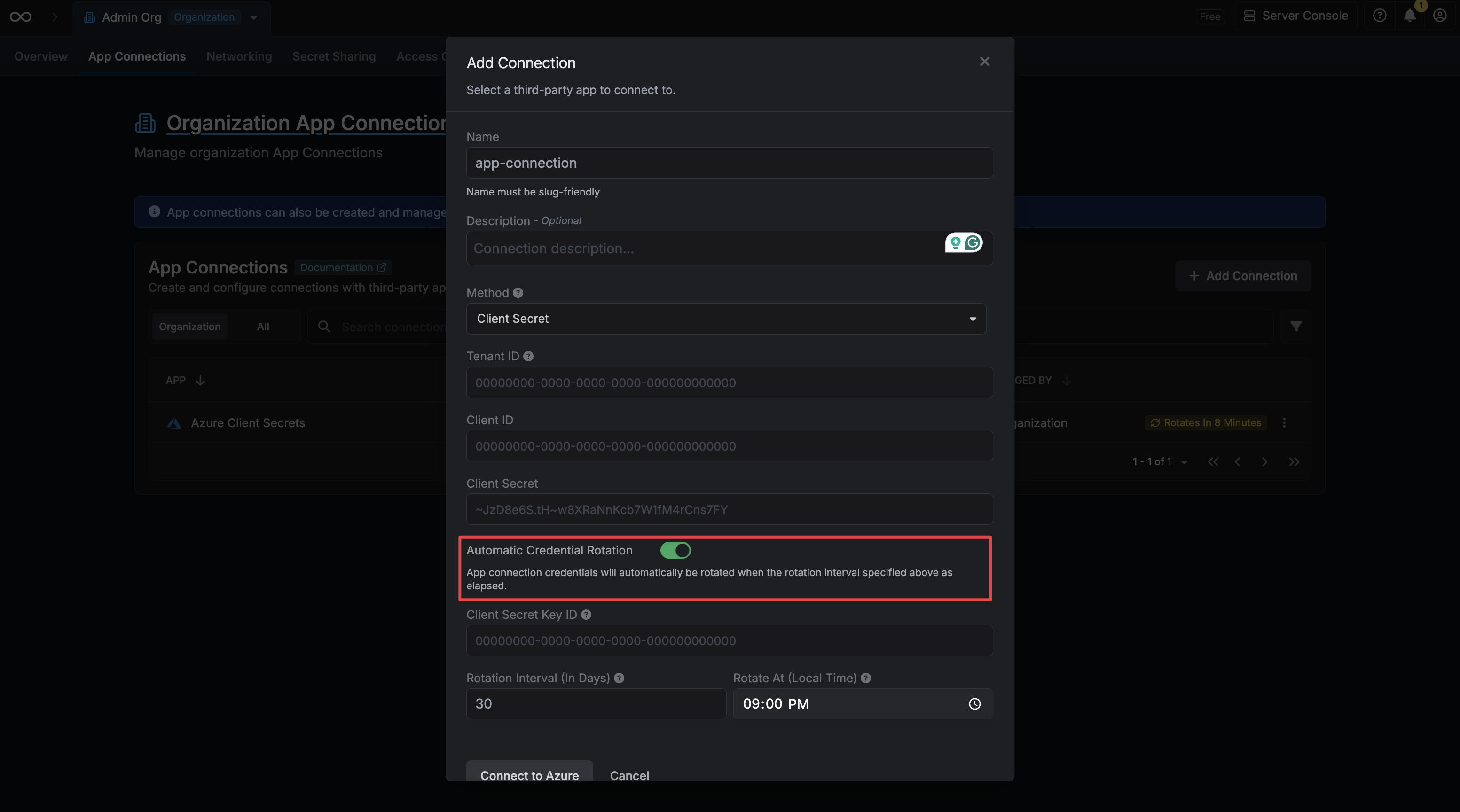 Enter the **Key ID** you copied in the previous step into the **Client Secret Key ID** field. Infisical uses this to revoke your original secret after generating a new one.
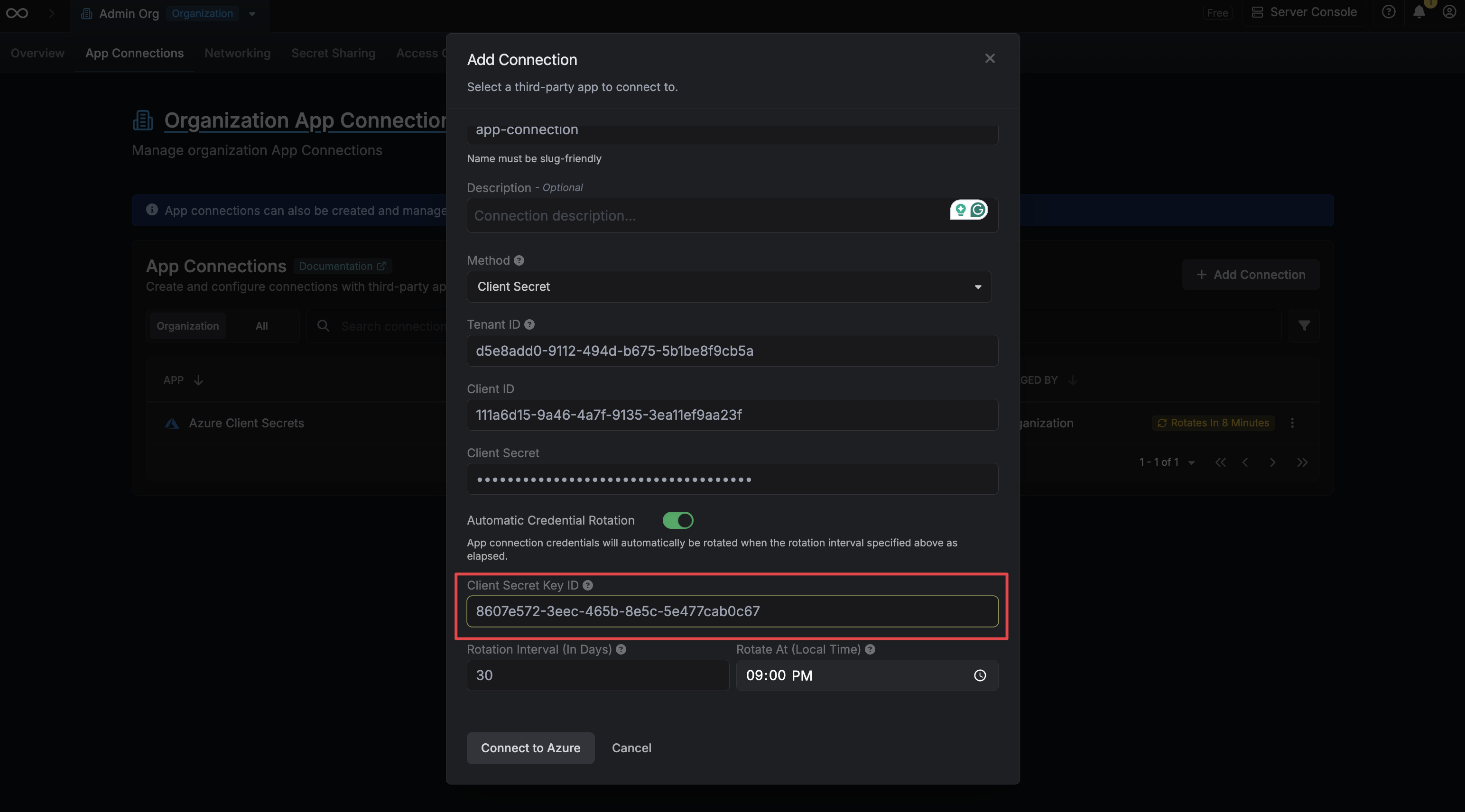 Set the **Rotation Interval** (in days) to define how often the credential should be rotated, and set **Rotate At** to the local time of day at which the rotation should occur.
* **Rotation Interval** – How many days between each rotation.
* **Rotate At** – The local time of day at which the rotation will be triggered.
Set the **Rotation Interval** (in days) to define how often the credential should be rotated, and set **Rotate At** to the local time of day at which the rotation should occur.
* **Rotation Interval** – How many days between each rotation.
* **Rotate At** – The local time of day at which the rotation will be triggered.